Story
The Supercar Eraser: When Japanese Kids Turned Stationery into Racing
In 1977, Japanese kids were racing 20-yen rubber cars across school desks. Nobody planned the game. Nobody wrote the rules. And the erasers couldn't erase anything — but nobody cared.
Before YouTube, before the internet, Japanese kids sat around a record player and tried to identify supercars by the sound of their engines alone. Ferrari. Lamborghini. Porsche. Each track was a different car, and whoever named it first won. Looking back, it sounds insane. At the time, it felt completely normal.
This was Japan in 1977 — and into that fever, someone had the idea to sell toy cars disguised as erasers.
The Boom That Consumed a Generation
It started with a manga. Circuit Wolf (Saākitto no Ōkami), serialized in Weekly Shonen Jump from 1975, followed a young street racer tearing through Japan in a Lotus Europa. The story hit at exactly the right moment. Japan's postwar economy had finally produced a generation of kids who could dream about Ferraris and Lamborghinis — cars that existed in magazines, on TV, and almost nowhere else.
Supercar spotting became a genuine hobby. Boys would stake out intersections known for wealthy car owners, waiting with cameras for a Countach or a 308 GTB to roll past. Supercar exhibition events drew massive crowds. The record player quiz wasn't a joke — it was just another symptom of a country completely, collectively obsessed.
The problem was access. A real supercar was untouchable. A diecast model was expensive. You could only own so many.
The Eraser That Wasn't Really an Eraser
Then came the supercar eraser — kā-keshi in Japanese, short for kā (car) and keshi (eraser).
They were sold in capsule vending machines (gashapon) for around 20 yen — the price of a small candy. Each one was a rubber supercar about 3 centimeters long, molded in a single bright color: red, yellow, white, orange. Ferraris. Lamborghinis. Porsches. The names were stamped on the underside.
They were called erasers. They could not erase anything. Nobody cared.
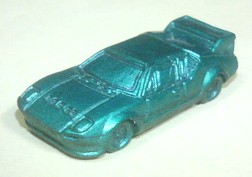
What they could do was go to school. You couldn't bring a toy to class — but this was technically a stationery item. The teachers knew. The kids knew the teachers knew. The argument was made anyway, every single morning, by boys across Japan sliding them into pencil cases alongside actual pencils.
For a 12-year-old in 1977, the kā-keshi was the closest thing to owning a supercar that money could buy. You collected your favorites — not the rarest, but the ones you loved. You owned five, ten, twenty of them, and each one meant something.
Three Ways to Race
Once you had the cars, you needed a track. Fortunately, you already had one: the top of your school desk.
The racing tool of choice was the knock-type ballpoint pen — the kind with a button on top that clicks the tip in and out. One firm press on the back of a kā-keshi, and it would shoot across the surface. The skill was in the pressure: too soft and it stopped short, too hard and it flew off the edge into disqualification.
Three formats emerged, as naturally as any sport organizes itself:
Race format. Players drew a circuit on a piece of paper or an open notebook — winding, cornered, full of tight sections that required finesse. Each turn had to be negotiated with a precise, angled tap. Different pens behaved differently. Regulars started to learn which pen to use for a hairpin versus a long straight.
Distance format. Simple, loud, and perfect for a crowd. Everyone lines up their car at the same starting point, and whoever launches it farthest wins. No track, no setup, no waiting. One press, instant results. Fifteen boys could play at once. The classroom became a stadium.
Sumo format. Two cars on a desk. The one knocked off the edge loses. That's it. No equipment needed. You could start a match in ten seconds anywhere. It was the most dangerous format for a modified car, for reasons that will become clear.
The Modification That Changed Everything
No kā-keshi was born equal — but with the right modification, any car could become fast.
The dominant technique: take a mechanical pencil lead (0.5mm), and press it into each of the four tire positions on the underside of the car. Four tiny points of contact instead of a flat rubber base. Theoretically, a near-frictionless surface. In the right conditions, a well-modified car would travel astonishing distances with a single press.
The catch was beautiful in its cruelty. In distance and race formats, the needle-point base gave you maximum speed. In sumo format, played on a flat desk with no walls, that same instability made the car nearly impossible to control — a single deflection and it sailed off the edge, losing automatically.
The best tool in one game was a liability in another. This forced a choice: specialize your car, or keep it general. Kids as young as ten were making decisions that any product engineer would recognize.
The Record That Shouldn't Exist
During the height of the supercar boom, someone released a vinyl record of supercar engine sounds. Not music with car noises. Just the engines — each track a different model, clearly labeled on the sleeve.
It sold. Of course it sold.
On weekend afternoons, boys would gather around a record player, drop the needle, and try to identify the car from the sound alone before anyone else. The Ferrari flat-12. The Lamborghini V12. The Porsche flat-6. They knew them the way other kids knew pop songs.
This is the world into which the kā-keshi arrived. Not just a toy, but a physical piece of an obsession that had no other affordable outlet. Which brings us to the other half of the story — the pen that became the most important piece of racing equipment in Japan's elementary schools.
The pen half of this story is told in Part 2: The BOXY Legend.
Products mentioned in this story
Continue to Part 2
The car needed the right pen. This is the story of why one ballpoint pen won every race it never entered.